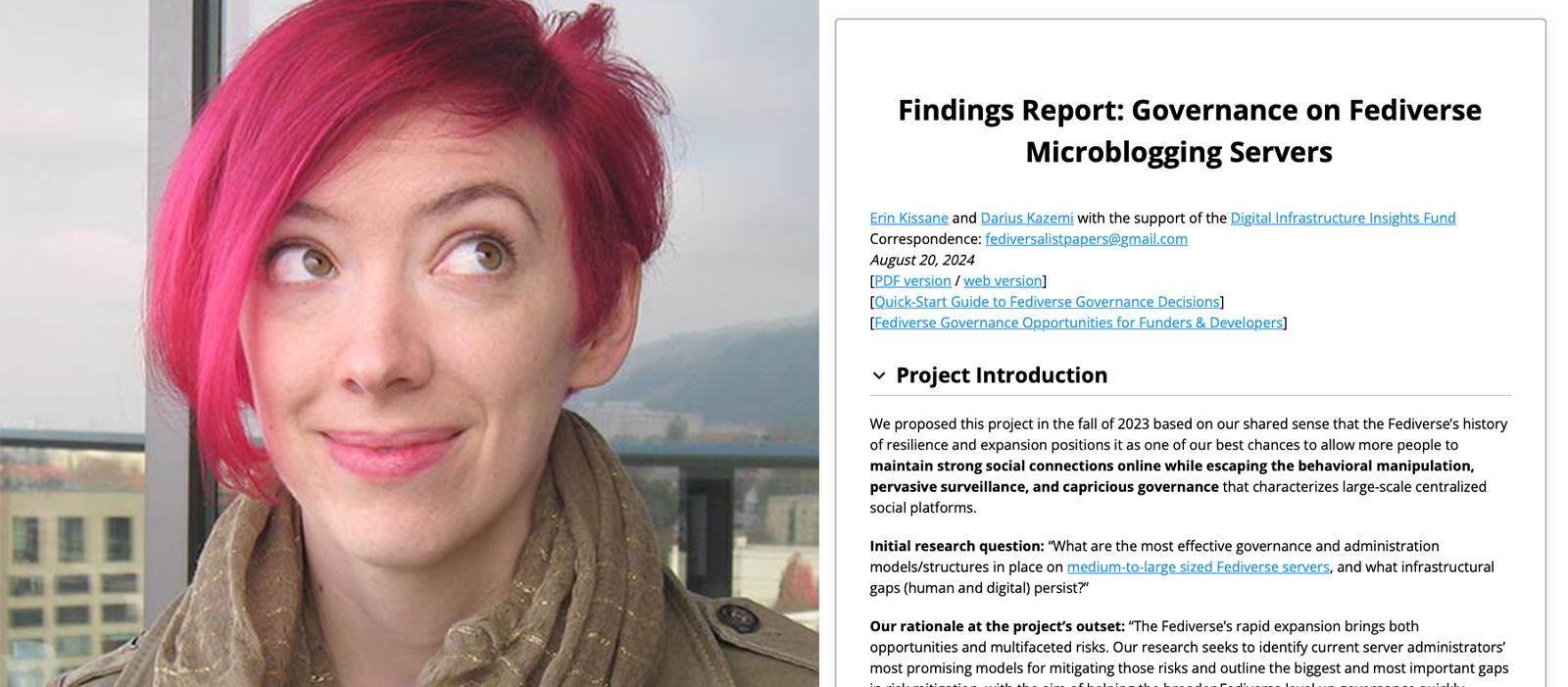


Part two of our interview with Erin Kissane is a deep dive into her work on the Fediverse. Why do people use it, how do they govern, and how can you, dear listener, get your own healthy Fediverse community going? Plus Erin talks about Blue Sky a lot.
Erin Kissane runs wreckage/salvage, helmed the COVID Tracking Project for The Atlantic, wrote Meta in Myanmar, and recently published a report on governance in the Fediverse with Darius Kazemi.
Transcript
Ethan Zuckerman:
And I think good governance is a really helpful term here. So I think you’re right to undercut this narrative of Facebook went from not caring to caring a lot to now not caring again.
I think you’re right that the impetus is not to care that there was a certain amount of performative caring at a moment of trying to satisfy the press, possibly to satisfy employees. There was a moment of real employee labor and organizing power and at a moment where people did have the ability to jump ship and go somewhere else. This idea of how would you like to work for a company that isn’t implicated in genocide might have actually been a very important force.
But let’s look at sort of the opposite of this for a moment. With Twitter becoming X, we have a platform that again could hardly be accused of good governance, but certainly is not afraid of putting its thumb on the scale. Talk a little bit about this other form of platform failure where platforms are propagandists.
Erin Kissane:
I mean, I do think it’s hard to overstate the absurdity of a moment when the president of the United States and the sort of shadow president of the United States both separately own their own personal social media platforms.
Ethan Zuckerman:
I’ve been trying for terms for most time. I’ve been trying like vizier. I’ve been trying co-president, consiglieri, I mean, whatever we end up using. But yeah, no, you’re right. Yeah, they’re both platform administrators.
Erin Kissane:
It’s wild. That’s completely wild. And of course, there are correlates to this. We’ve seen extraordinarily wealthy and powerful men own newspapers before. We know how buying your way into controlling the narrative works. And I do think that’s, I think there are genuinely really useful correlates in our recent history and our present with perhaps the Washington Post and to some degree the LA Times.
We know how that works. We see that powerful people understand the value of controlling the narrative and buy their way into controlling the narrative and lifting up propaganda and various kinds of information disorder and warping collective reality.
Henry Farrell’s great post on his Programmable Mutter, if I remember correctly, his newsletter about sort of the degradation of collective reality is something that I come back to all the time, like misinformation, disinformation, information disorder. We’ve had a lot of different ways of talking about this.
But the idea that we have both sort of bespoke realities—which I take from Renée DiResta great work—and Henry’s sense of just warped collective realities.
If you can just buy a platform and use that to spin out your own series of bespoke and deeply troubled reality-warping machines, that’s an obvious move. So in some ways that feels to me like maybe effective, but much less broke problem. This is an old thing. This is just seizing the public conversation.
And the fact that so many organizations, including newsrooms, institutions, public agencies, had ceded their public communications to Twitter when it was Twitter and did things like emergency broadcasting on Twitter, really important public comms on a private platform that could be bought, captured, and turned into a propaganda acceleration machine by a billionaire, I hope is in retrospect obviously a foolish move.
But we are seeing experiments with other ways to do it. And the Fediverse is one of those, I think, the atmosphere, the app protocol ecosystem that’s building up around Blue Sky and their work on that protocol. There are others, you know, Nostr’s got their own thing going on and there are other experiments even outside that group.
I don’t know that any of these new networks, well, new, the Fediverse isn’t new, but I don’t know that any of these sort of alternative decentralized and non-centralized networks are the thing that’s going to get us out of this. But they are experiments in trying new ways of governing and distributing speech.
And I think that that’s essential, because it does seem clear to me that the other way is not working. It’s vulnerable to corporate whim, it’s vulnerable to capture, as we saw with Musk. And it’s just, it’s vulnerable to, you know, callous and inhuman structures, which is what we saw with Meta and continue to see there.
So I think trying different ways of rebuilding a public square that is actually public, fruitful experimentation, not going to get it all right, maybe get none of it right. But what I keep coming back to is like, perhaps we could begin by learning what went wrong in as much depth as we can tolerate and then make different mistakes, make new mistakes, fall in different holes instead of the same one. So that’s why I’m so excited about the possibility of these new and alternative ways of doing networking.
Ethan Zuckerman:
So I want to, I want to knit a couple of those threads together. So you mentioned that many public services, agencies, others ended up leaning on Twitter as an emergency broadcast system.
I think in many ways, Twitter at its best became an infrastructure in the same way that YouTube is sort of the default infrastructure for here’s where you put video content, whether or not you’re dealing with the algorithm, the recommendation system or not, it’s just, here’s a useful bit bucket, that’s where we put the video.
Twitter became for many people, this is a quick delivery service. It’s got a backdoor into the media, it’s powerful for all sorts of different reasons. It may not reach everybody, but it’s going to reach a whole lot of people.
And then, as you said, Elon Musk bought it and turned it into a bespoke reality-creating machine. And it’s broken for its original function. It may function fairly well in its new function of bespoke reality creation. It doesn’t seem to have swung the German election, but, you know, papers will be written, analyses will be done, we’ll sort of see where we end up on all of this.
It seems like having a platform that is owned by a corporation that could be bought by a billionaire is at this point a known vulnerability. And it would seem like a lot of people at that point would choose to move onto the Fediverse rather than onto Blue Sky. But I got to tell you, that’s not what seems to be happening, at least in terms of mass movements at the moment.
Give me some insights. You’re someone who’s worked very, very hard on helping people think through the Fediverse. Why has this been hard? Why has Blue Sky had an easier run of it? Give us a bit of a state of the art of small social networks right now.
Erin Kissane:
Sure, sure. You know, we saw a pretty big wave, several waves of Twitter migration that did bring a lot of people into the Fediverse. And some of those people stayed. But until, you know, the day after the election last November, there were still just a ton of people who went back to Twitter because that’s where their people were. And that’s how social communication works.
It’s very hard to go resolutely hang out someplace where your people are not. That kind of defeats the purpose of doing, you know, social network communication.
So I think a lot of people tried it out on the Fediverse. And I don’t think that the story is over on the Fediverse. It is true that clearly recent Twitter migrations, X migrations have landed for the most part on Blue Sky.
And, you know, Blue Sky had a number of obvious advantages. They were building the protocol and the reference app that became a platform at the same time. They had some money. They were able to move very quickly on interface concerns and, you know, sort of make some of the intrinsic complexities of decentralized networking less of a barrier for people who wanted to move on to Blue Sky.
Blue Sky still feels more like Twitter. So for people who had, you know, for whom Twitter was a big part of their lives or even just like the casual place that they used to check in on news and friends, it’s a friendlier, more familiar zone. The Fediverse is not just masted on, it’s lots of things, but masted on is where most of the user base has been. And it’s Twitter-like in certain ways, but really importantly not Twitter-like in ways that I think become clearer once you actually dig in and start trying to rebuild your network and get situated.
It looks enough like Twitter that people came in with a lot of expectations. But it doesn’t work like Twitter in ways that I think a lot of people found disorienting, confusing, in some cases alienating. It’s also just a different user base. There are a lot of people on the Fediverse who were early refusers of platforms and extremely uninterested in, you know, having any kind of cultural movement toward anything that Felter smelled like, those big, frequently toxic platform dynamics. So, you know, it was a rough transition for a lot of people.
And then it just, I think a lot of it is just critical mass. There weren’t enough people who stayed around long enough on the Fediverse for the big, subsequent waves of migration to naturally flow there. So, a lot of folks have wound up on Blue Sky instead. There are other modes of being on app protocol services outside of the Blue Sky app. Those are still nascent, but I think getting stronger and stronger and more interesting. And I think we’re going to see sort of an explosion of other ways of working in that protocol.
Also, you know, I’m especially interested in ways of internet working and seeing the possibility of services and tooling that allows people to either stay on the Fediverse where they want to be because it matches their ethical frameworks best or their technical preferences or is just not owned by a company, which Blue Sky is, who can be on the Fediverse and easily follow people on Blue Sky or perhaps in some cases on threads. And vice versa, people who want to be on Blue Sky because it feels easy to use and familiar, but can also follow people who chose to either stay on the Fediverse or move to the Fediverse because it feels safer for them.
So, in full disclosure, I’m on the board for a relatively new organization that came out of the Bridgy Fed work that Ryan Barrett had built to start making technical bridges from the Fediverse to websites and various other things. A New Social is the name of that organization.
And they’re really trying to explore, like, what is the most we can do with these frankly, technically kind of inelegant, but socially very productive bridges that allow people to functionally sort of flow across decentralized networks and maybe knit together some of the networks on different protocols who, you know, you can’t follow someone directly on Blue Sky if you’re on the Fediverse and vice versa. But if you use the bridging technology, you can. You can make your account bridgeable. You can follow bridged accounts.
I think that reduces a lot of barriers in really useful ways for people who are interested in genuinely replacing their centralized platform experience with maybe a more patchwork, maybe a less elegant, but maybe much healthier set of ecosystems that are either decentralized in the case of Blue Sky, which is trying very hard to decentralize itself or genuinely non-centralized, never centralized to use one of Robert Gell’s Fediverse scholar Robert Gell’s formulation. The Fediverse wasn’t ever centralized. It can’t be centralized. You can’t do it. You can’t buy the Fediverse. You can’t, you know, it’s not possible.
Blue Sky is still in a situation where there is a company that needs to have funding that could theoretically be purchased, but I think that team is trying to sort of throw overboard as fast as possible resources that allow people to more fully decentralize that ecosystem. So I think there’s a lot of good stuff happening there.
Ethan Zuckerman:
So also in the spirit of full disclosure, you know, one of the projects that we run here at the Initiative for Digital Public Infrastructure is an approach to bridging through aggregation, where through Gobo.Social it’s possible to be following people both on Blue Sky and on Mastodon. So we’ve spent a lot of time within these spaces.
As a relatively sophisticated user within this, as a developer within this I found a couple of situations in which I’ve been surprised at some of the implications of the decentralization of Federation and the ways in which it is in fact not Twitter.
So here’s my little story on this. I joined Mastodon in 2017. I joined a node called Octodon.Social. I chose it very specifically because it was a queer-friendly, trans-friendly, EU-based server. I had enough concerns about anti-queer sentiment in the United States and the Trump administration that I thought would be a good idea to have a server in the EU.
And I largely didn’t think about the administration of that server until 2022-2023, at which point the server admin, like a number of trans people, started feeling like the New York Times had become explicitly anti-trans, began blocking links to the New York Times, began defederating from servers that had journalists who were linked to people from the New York Times. And very quickly, half of my social network as a media scholar no longer worked.
Eventually, the admin got sick of being involved with those problems, decided to shut it down. At that point, I had already migrated over to social.coop, where I’m one of the co-owners of the server and part of a collective distributed administrative team.
Help me turn that into a happy story rather than an unhappy story. For me, it was a very strange moment of, “Oh my God, I guess this is how Federation works, right? We can have local rules for local servers. Ideally, I can migrate, I can go somewhere else.” At the end of the day, I was able to end up doing that.
You have made the case that Fediverse instances can focus on being the right thing for a given group of people. Give me the plus side of that story, Erin, because that was a lot of work on my part to suddenly realize, “Oh, this is not just as simple as getting my way off of a more socially acceptable Twitter alternative.”
Erin Kissane:
Yeah, I mean, first I want to recognize that that’s a really real thing. And particularly, I mean, there’s two things. One is that Fediverse servers just shut down. Things happen. Hardware goes down and sometimes people burn out and sometimes you get noticed and can actually migrate your account in time. And sometimes you can’t. That’s a real problem. That’s a real infrastructure problem. And it’s something that hits folks on the Fediverse, Activity Pub protocol side of things really hard. So that’s real.
The other thing that’s really real is that all of the messy, and I mean, like small politics—as in “polis”—the work of building societies together is really exposed on the Fediverse. And that is a level of messiness that I think people are not necessarily prepared to confront in their social networking experiences.
Some people really are, and those people are doing things like starting cooperative servers and collectives and they’re called unions in a lot of European countries, doing experiments with participatory governance and democratic governance of servers. And I think that’s wonderful and necessary. And I love to see those experiments happen.
I mean, on the positive side, we do see things on the Fediverse where groups of people who are typically heavily over moderated on not just centralized platforms, but anywhere where their norms are ill-understood can find homes on Fediverse servers that understand them.
I did a really in-depth Fediverse governance research project with Darius Kazemi, who’s at the Applied Social Media Lab at Harvard now last summer. And we spoke to, among other people, someone who runs like a leather kink server on the Fediverse where those norms from that community are the norms of the server. And the way he talked about it was like, if you wouldn’t do this in a leather bar, don’t do it on my server. But otherwise, it’s fine. And when I get in reports because someone posted a picture of their butt, I’m not going to do anything about it because it’s fine here. It’s explicitly okay.
Ethan Zuckerman:
I’ll just jump in and mention the late great Switter, which was a Fediverse instance from 2018 to 2022, which was put together and run by sex workers in Australia. They were working from a part of Australia where sex work was legal. They were responding to the disappearance of Backpage and a number of other US-based tools.
And they managed for five years to create a space that did have its own rules. It served a group of people who are very, very vulnerable online. And it worked really, really well up until the point that Australian law made it essentially impossible to continue running it.
Erin Kissane:
Thank you for bringing that in. I think making sure that Switter is included in histories of Fediverse governance is really important and is such a great example.
The local norms, the benefit of having local norms is not exclusively something that’s important for a server, for communities that tend to be suppressed and repressed elsewhere. It can also just be about any communities, political orientation. There are anarchist servers on the Fediverse. There are highly local servers that deal with a specific, literal geolocations needs and politics and so on.
So the thing about the Fediverse is that servers are where you have your identity, right? Your account is linked to a server. This is both a strength and a weakness. It’s a weakness when the server goes down and you can’t move everything unless you have time to migrate and you can’t migrate your posts when you go. So it’s lossy.
But the strength is that servers can function as small political entities and then choose with whom they will federate. Right now, the Fediverse is by default open, but there’s a lot of work happening on making sort of closed or island or archipelago networks where you don’t by default open to connections with every other server on the Fediverse. You choose to federate with other servers whose orientation is compatible with yours. And I think that’s super interesting and going to produce useful effects, I think it’s particularly essential under authoritarian rule in various places.
So for the folks who are really interested in being informed and active participants in the political work of trying networked modes of society, the Fediverse is hard to beat for that.
But I will also say that there’s some super interesting things happening on the ATmosphere side: Black Sky. Rudy Fraser is the person who started that—Rudy comes from a mutual aid orientation. And the way that Black Sky, which is a set of technologies and a cultural institution on AT Proto works is very informed by a collective orientation. The people who work on that project are compensated.
Rudy is finding ways to plug into pieces of the network economy that allows Black Sky to build services to protect and take care of and serve a community of people who are typically among the most abused and targeted and harassed on both centralized and decentralized platforms.
Being obviously Black on the Fediverse is not often a great experience. It’s not that these new networks come without the biases and patterns of harassment and abuse that we built together offline and then online over the last however many centuries.
So even in cases where with Blue Sky you don’t have a server where you’re federating as a community with other people, but what Rudy and his team have done is like they’re kind of building their own place even though it’s not located on a machine. They’re using other affordances of that network to build a place, something that feels like it has boundaries and protections.
And so I think seeing the cultural work of making place and making affordances for community protection and governance according to local norms is going to keep happening across these networks. And this is the thing I think I’m most optimistic about is whatever the affordances of the technology people are finding ways to do interesting and beneficial, benevolent, honestly really beautiful work for their communities.
North Sky is one that’s just starting up on Blue Sky that’s a trans-owned, –run server, well service, it’s going to be its own AT view on the ATmosphere system and it’s based in Canada for reasons. So I think this is where it’s at.
Ethan Zuckerman:
So something that’s hugely useful for me about this, Erin, is that I think I have often felt like the Fediverse inherits a great deal of politics from say the open source movement. And you have a lot of people who are very technical, are very ideological, have really good aims, and often don’t care if they’re off by themselves talking to a lot of other people who feel the same way.
The truth is the history of online community is a history that’s largely been pushed forward by marginalized communities. I had an amazing example of this the other day. My students work on case studies of healthy internet communities and my students were coming to me with possibilities for a paper and someone came and said, “I just heard of this movement called Furries.” And of course I started laughing and like with zero preparation gave like a 20 minute history of the relationship between the furry community and internet community because for those of us who study internet community, the furries have been enormous pioneers in all sorts of different spaces.
So I feel like what you’re telling me is actually very interesting, which is that maybe we’re getting beyond the moment where people are starting their own servers because it’s open source and they want to do it and they are Linux users and so on and so forth. But now we’re actually starting to set up these communities because they are part of a different marginalized group of one fashion or another need to create a safe space where governance ends up being part of it.
In your spirit of being both illuminative but also tremendously practical. I would love if we could close out with you just talking about some of the writing that you’ve been doing to help people think about how they get started on the Fediverse, how they govern within these spaces, some of the work that you’ve done on your own, some of the work that you’ve done with Darius.
Help us just sort of get oriented in that space for people who are looking at this and saying “I get it, my group needs to be able to self-govern. We’re willing to do that work.”
Erin Kissane:
Thank you. I’d be very happy to do that. I think for folks who are starting out who are really interested in the governance side of especially the Fediverse, the findings report that Darius and I put out at the end of last summer is available. I’m sure you have show notes we can link to it from. It’s long, it’s another like many, many thousands of words but it’s pretty well organized.
Ethan Zuckerman:
Another 40,000 pages.
Erin Kissane:
Another 40,000 pages. I’m so sorry.
That work is, there’s synthetic work and there’s some theoretical work in organizing it but the real value in that material, in my opinion, is that it’s the collected insights and hard-won knowledge of people who’ve been doing this work on the Fediverse for quite a long time.
The only reason we did this work is that I kept looking for it. I was like, “So who’s done the sort of ethnographic thing that explains how this stuff works?” And it didn’t exist. The Digital Infrastructure Insights Fund agreed to throw us some money so that we could run on just taking that knowledge, well, taking is the wrong word. Doing a participatory knowledge building project with these extremely generous and insightful and deeply thoughtful folks running specifically thoughtfully governed Fediverse servers.
I don’t want to suggest that this is necessarily even the majority of what’s happening on the Fediverse. There are a ton of people who are still doing Fediverse experimentation because they’re super into open source. It’s great that there are a ton of servers that are mostly happening because people are doing experiments with what you can run on entirely open protocols. That’s great. Our focus was on the people who are trying to do it in governance forward ways. We were able to collect up a lot of, I think, really useful stuff with those teams and make it all available. Those are some good starting points.
We did try to do enough synthesis and sense making on top of that work that I think you can go in as someone who’s interested in that work and find interesting tracks depending on how much you’re concerned on the tooling side versus the socio-cultural side. There’s that.
I have been doing a little less network writing over the last couple of months because I’m in the process of standing up a new organization with some old friends to use some of our networked community power to do some collective sense making for folks who are living through the dismantling of the administrative state and weaponization of the federal government in the US specifically.
On the site where I’ve been writing most recently, wreckage/salvage, that has just my continued pecking away at the work of people like Ursula Franklin. I have a series of Eleanor Ostrom-centric posts from the commons world that I hope to get up relatively soon. There’s quite a lot on there, also on erinkissane.com—I have the archive of the past couple of years of just trying to get my own head into what are the affordances in the Fediverse that are tripping people up? What are the things that aren’t well understood?
One of the odd things, I guess it’s just a side effect of the fact that the Fediverse has tried to be less indexed and indexable and less of an easy target for surveillance. It’s hard to understand what’s going on a lot of the time. That’s just I think one of the trade-offs, but I’ve tried to pull some of the information that is maybe useful but less easily found into some posts on those two sites.
I guess a little bit of it connects to the Blue Sky stuff as well, but most of my work has been on Fedi because I’m a believer. I think it’s a great set of technologies that has a long way to go. I’m really excited about the work that the Mastodon team is queuing up for the next year. I think there are some fantastic people working on that project.
Every so often I talk to someone who’s like, “Well, it just seems like Blue Sky’s got the momentum, so that’s where everything’s at.” I think Blue Sky’s doing really interesting work. I’ve talked about them a lot today, but the model of the Fediverse is still, I think, meaningful and important and exciting. So I have a lot of optimism about the next 12 to 18 months of sort of taking what we’ve all learned collectively over this past many years and trying to make places and tooling on the Fediverse that can be welcoming and safer for more communities who may need more aggressive forms of safety.
Ethan Zuckerman:
Erin, I’m enormously reassured to know that you’re putting your substantial intellect and energy towards this bigger question of how we survive the next three years, nine months, number of weeks, etc., etc., or perhaps just how we survive the dismantling of not just the administrative state, but frankly so much that goes with it. I will tell you that as a professor at a university on the list of 60 universities targeted by the administration, these changes are enormous and profound and all over the place.
You are, as you always are, tremendously illuminating and I think for people who need more illumination around the Fediverse, we will definitely make sure to share some of that writing.
She’s Erin Kissane. She’s one of the smartest folks I know at pulling apart incredibly complex socio-technical issues, looking at paths through them that transcend the easy solutions of critiquing or fixing, but really look towards illuminating the complexities of them. Erin, it’s just an honor and a pleasure to have you here. Thank you so much for being with us.
Erin Kissane:
Ethan, thank you so much for giving me this opportunity. It’s also just really wonderful and heartening to get to talk about this stuff with you, or someone whose work I’ve respected and gone back to for so long and it’s good for the soul. Thank you. The listeners can’t see how pink I am, but thank you. You’re far too kind.