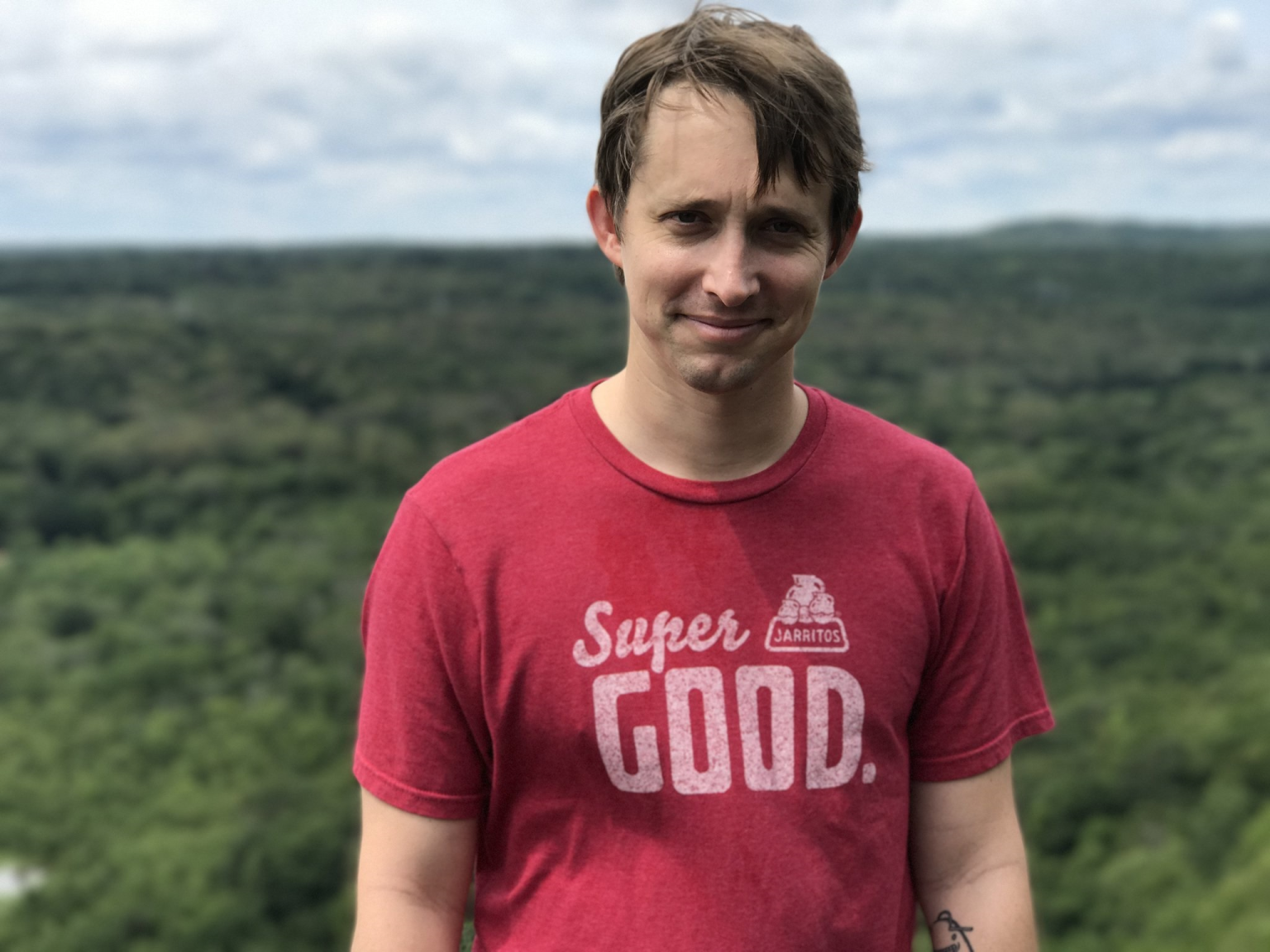


Kevin Rothrock has been reporting on Russian culture and politics since the mid-aughts, and as the English-language editor of Meduza, he’s a crucial figure in helping the English-speaking West understand the day-to-day in Putin’s Russia during the war in Ukraine, and on the front lines too. This week on Reimagining, Kevin Rothrock tells us how he does it, all remotely from the US.
Kevin Rothrock is the managing English-language editor at Meduza and host of their podcast The Naked Pravda. He formerly wrote for RUNet Echo as part of the Global Voices project and hosted the podcast The Russia Guy.
In this episode, Kevin mentions his interview with anthropologist Jeremy Morris.
Transcript
Ethan Zuckerman:
Hey everybody, welcome back to Reimagining the Internet. I am your host, Ethan Zuckerman.
I’m here with Kevin Rothrock, who is the managing editor of the English-language edition of Meduza. Meduza is a remarkable source of independent information on what’s going on in Russia today.
Kevin is an amazingly experienced Russia guy. He used to produce a podcast called The Russia Guy. He now focuses on a podcast called The Naked Pravda on Meduza.
We know each other from his time as the editor of RuNet Echo, which was a great project that came out of Global Voices, helping bridge between the Russian language web and audiences all over the world. He’s also edited the web edition of the Moscow Times.
Kevin, thank you for being with us.
Kevin Rothrock:
Thanks for having me.
Ethan Zuckerman:
So I’ve got to start with the question. How did you become the Russia guy? I understand it. You don’t have Russian family. You don’t have sort of obvious ties that would lead you to spending your life essentially translating Russia for English-speaking audiences. How did you get started and how did you sort of level up to the point where you’re one of the most important voices helping English-speaking audiences understanding what’s going on in the Russian-speaking world.
Kevin Rothrock:
Yeah, it’s true. I don’t have any Russian roots actually. My childhood friends and my family think it’s very weird that I went into Russia stuff. I grew up in the San Francisco Bay Area, so a lot of my childhood friends went into tech. And so not only do they think it’s weird, but they think that I missed out on a lot of money. And they’re right about that.
But actually, there’s not a really good reason here. Basically, it’s just the people that I I met along the way, it kind of gave me reason to stick with it. I have interest in Russia, like the, the culture and everything I’ve learned about it has, has kept me going. But honestly, the biggest reason is just the people I’ve met, you know, while studying the language in college at UC Santa Cruz, and then again, at UC Berkeley and just along the way, just the people I meet have kind of given me reason to keep going, I guess.
Ethan Zuckerman:
You’ve told some other interviews in the past that this is part of just being a Cold War kid and watching the spy thrillers and things like that. When you first traveled to Russia did you have that you know sort of frisson of danger and excitement that came from it or or did you end up experiencing something very different than what you then you expected?
Kevin Rothrock:
I mean the first time I was in Russia I was 20 and actually turned 21 while in Moscow. It didn’t really mean anything to do that in Moscow. I think I went to a pizza parlor and ordered myself a non-virgin strawberry daiquiri. I thought I always wondered what this would be like. Actually, the virgin one tasted better in my mind. I don’t think I really felt that way.
Today, I imagine it’s closer to the spy thriller thing. For one thing, I’m not allowed to go back. The foreign ministry has added me to one of their, you know, their, um, “you can’t come in” lists. And also the fact that Meduza is banned in Russia. Working for them is illegal. And so if I were somehow to find myself in Russia, who would definitely be a, how do I find the border and get out of here in the trunk of a car, whatever I’ve got to do. It would take on those vibes then.
But no, I mean, when I was first there in 2003, that was when I was 20 turning 21, I was just kind of felt like being, you know, any dumb American abroad, you know, probably doing stupid things, drinking too much. And that sort of, that sort of dumb stuff.
So no, I wouldn’t say that being there had those vibes at those times.
Ethan Zuckerman:
Russia in 2003 had a sense of opening up and sort of transforming that’s obviously a little different.
Kevin Rothrock:
It felt like it was closed. I was already kind of closing up actually because I was there when Khodorkovsky was arrested on the tarmac in Siberia or somewhere out in the east. And I remember that my Russian language instructors—at this point people that were cooperating with the UC Education Abroad Program—EAP—they seemed to have from what I remember like kind of liberal-leaning attitudes. And I remember one of the phrases that I for some reason memorized that I was able to repeat for some Russian friends when I got back was, “Ходорковский сделал свой бизнес прозрачным,” which means “Khodorkovsky made his business transparent,” which is a sort of propagandistic, kind of like, “Yay, Khodorkovsky!” and he didn’t really do that, incidentally. But that’s just sort of indicative of the leanings of the educators that were working with the UC EAP.
But I remember when he was arrested, it was very distressing to some of the teachers and they were keen to kind of make us aware that bad things were afoot.
By the time I got there, Putin had already been in power for almost three years, not quite three years.
Ethan Zuckerman:
So you’ve really only known the country in person in the Putin years? But obviously there’s been a massive transformation, you know, from sort of one space to another. When’s the last time you were able to visit?
Kevin Rothrock:
I was there in late 2019. And I had a great time, actually. It was really fun. Because at that point, I’d already been with Meduza for several years and I’d been with Global Voices doing RuNet Echo and had contacts and friends who were based there. At that point, I’d gotten to know remotely and through people visiting the States, several foreign correspondents working in Moscow. It was pretty exhilarating actually.
Maybe some listeners out there also work remotely and they’ll know that never meeting colleagues in person or even anyone outside your immediate family can have certain psychological effects. And so when I was in Moscow actually seeing people that I correspond with or read, it was kind of like, “Oh, wow, you exist. I exist. How fantastic is this?”
Ethan Zuckerman:
Well, and this is in some ways very characteristic of Global Voices as a whole. Not everyone who who listens to the show knows about Global Voices. Global Voices is a project that’s been going on for about 19 years now. Rebecca McKinnon and I founded it at Harvard many, many years ago, and the goal was to try to bridge between what’s going on in media, in other countries, and what conversations people are having around the world, and what conversations we’re having in the English-speaking world. And of course, it’s sort of grown from that into just trying to bridge conversations between gaps of language and culture.
What was the work that you were doing with RuNet Echo? Talk to me a little bit about that and sort of what you learned in that process of working remotely with people who may not have thought of themselves to speaking to the rest of the world.
Kevin Rothrock:
I sometimes am not sure if I’m speaking to the rest of the world. But I always thought of the work as kind of trying to keep your pulse on the Russian blogosphere. And I know that the blogosphere is sort of an outdated concept in many ways. But actually, in Russia, I think it has more stickiness maybe than it does in lots of other places. Back when I was doing it, when I started, it was still a lot of the movers and shakers were still on LiveJournal. And then they gradually left LiveJournal. But today actually there’s a whole new community really on Telegram and it’s not like a one-for-one transition, but I think you can still definitely talk about the blogosphere on Telegram and have it mean something. By mean something, obviously that’s kind of a vague phrase.
But I guess what I would say is certainly when it comes to certain communities, like there’s the so-called Z bloggers who who are these kind of like pro-invasion, self-described war correspondents often, which means that they are literally in the field, talking to soldiers and kind of like reporting on it essentially. But they have like a pro-invasion agenda often. Some of them are ideological and kind of imperialistic ways and so on. But there is like a real set community. People have done network studies on this and shown how they repost each other and mention each other and have possible financial ties to each other. Very similar to what used to be done with LiveJournal.
And at RuNet Echo, we would track this stuff and we would try to report on trends and on communities and basically try to convey to English language speakers. And GV did a lot of translations too. So anybody, if it was translated, then it was available to these other readers as well. But yeah, we were kind of just looking to monitor, I guess, these like ongoing conversations that were reflective of groups and phenomena.
Ethan Zuckerman:
And just to make sure that we cement your credentials as a tool of the CIA underground conspiracy: RuNet Echo, I believe was supported throughout by various Open Society Foundation.
Kevin Rothrock:
Yeah, Soros money.
Ethan Zuckerman:
Which is to say Soros money, which you and I are both implicated within. But actually it’s a good example of I think what Soros really was trying to do, which was to sort of open up information channels between what was going on in the Russian speaking world and the rest of the world. GV does a ton of work sort of translating and bridging between different groups. Russia was really, really hard to do.
Were people that you were working with who were writing on LiveJournal, who were writing on some of these different platforms, were they suspicious of motives? Were they open to this idea of you sort of opening those conversations to the rest of the world?
Kevin Rothrock:
It’s hard to know what people seriously thought—but it was like an instant sort of joke. As soon as I had any kind of reputation as somebody who was like involved in watching these people, there were jokes that I was like a CIA guy or you know, Soros-slash-CIA guy.
And I would like to ask for interviews with some of these people. And I had a habit then of trying to get people from like the pro Kremlin side to talk to me and do interviews and comment on things, just kind of give responses to questions about their work and so on. They were more responsive than they probably would be today. I mean, for one thing today, it could be construed as a crime to actually talk to somebody like me so they would probably say no and not even answer or whatever.
But yeah, they were actually, I think they were happy for the attention honestly because it’s interesting to get contacted by somebody on the other side of the world who’s reading your work. I think they honestly did think they were talking to somebody who was affiliated with the CIA or something and they just assumed, “Well, I’ve got nothing to hide from Uncle Sam. I’m going to tell it like it is.”
Ethan Zuckerman:
I love the idea that somehow in the conspiracy theory world that the CIA and Soros have been sort of merged into one single sort of, you know, given how far left Soros is and how far right the CIA generally ends up being.
I think this question of what are the motives in sort of trying to translate for a different audience always ends up being an interesting question. I’m sure you experienced that a little bit now with Meduza in English. Let’s talk just briefly about what is Meduza and how did it come about?
Kevin Rothrock:
So Meduza came about as basically a… Well I should begin with the beginning. There is and was a website called Lenta.ru, which was an independent news website. Early on when the Russian media was pivoting to these online channels, not just newspapers with websites, but actually online projects that were entirely online, Lenta.ru shot to the top. It was a very big success.
After the annexation of Crimea, when there was still the unpleasantness in The Donbasa, the Lenta.ru published, I think the story, the history here is that they published an interview with someone who referred to a Ukrainian nationalist organization that had been banned in Russia or labeled extremist or something. And the owner of Lenta.ru, one of these oligarchs basically fired Galina Timchenko, the editor in chief for this slip up. I mean, it wasn’t really a slip up. It was just bad politics for the time.
Much of the newsroom resigned in protest because this was a form of censorship, intervention, that kind of thing.
Ethan Zuckerman:
And this is 2014 or so, right?
Kevin Rothrock:
This is 2014. This is all the way back in 2014. And then at the very, this is early 2014. So the annexation, if I’m remembering my history, was in March. And so come October, I believe, Meduza launches in Latvia. So it’s now outside of the reach of the Russian police, because obviously one of the issues with media outlets in Russia is that even if your benevolent oligarch doesn’t force out your independent chief editor, maybe the tax police suddenly show up and confiscate all your computers and suddenly you’re under investigation for this or that. And that has happened and certainly happened to a lot of opposition activists. There have been incidents where something like that happens to media outlets as well. But usually it’s actually the oligarchic owners that cave first before the police get involved.
But anyway, Meduza launches in, I think it’s October 2014. It is at that point a relatively small team, culled from the people that resigned from Lenta.ru. It’s based in Riga to be away from the police and so on. It’s a mix of news aggregation and then they have a small team of correspondents who are doing original long form reporting.
Here we are however many years later. That is still the core essentially. It’s aggregation of news from various sources, from news wires, from other independent news outlets. It’s like all the breaking news essentially. All the stories of the day in Russia and now very much in Ukraine and also just around the world. Anything of note. And then there is a whole there’s a much larger section now of original feature reporting.
Ethan Zuckerman:
How does Meduza work at a point where it sounds like simply asking the question, how is the war going, is enough to get you arrested in Moscow at this point? Are there still correspondents in Russia? Are there correspondents in Ukraine? How did those various types of reporting take place?
Kevin Rothrock:
A lot of reporting can be done remotely and the pandemic was, we benefited from the pandemic too. War, pandemic—it keeps us going. But that obviously taught a lot of people how to do remote reporting, which is something we were doing well before then too, but now a lot of sources are, I guess, more comfortable with it as well. So there’s still, that’s certainly very possible to do.
It’s illegal to have correspondence in Russia. It’s difficult to have correspondence in Ukraine. And these are the two locations that we focus on. So that’s obviously a big challenge. We do a lot of hiring of local freelancers. And so we’re familiar with these areas. And so we’re able to just contact people we know and hire them to report something. And we also publish things with no bylines. We do it quietly. We employ them quietly, I guess you could say. But we do what we obviously do. If you just go on our website, you’ll see we have plenty of room in these places.
Ethan Zuckerman:
And Meduza had an enormous audience in Russia at one point.
Kevin Rothrock:
We still do.
Ethan Zuckerman:
Well, so let’s talk about that because that’s non-obvious, right? The Putin government is obviously no big fan of Medusa. There’s been lots of discussion about Putin controlling the internet. How is Meduza finding an audience? Is it Russians in the diaspora or is it still Russians in country? Because the vast majority of content is coming out in the Russian language.
Kevin Rothrock:
I mean, Russia is still Medusa’s largest audience. It’s not the English language, largest audience, I think are, it’s not a majority, but the single largest block of readers of the English language content are in the United States. And that could be because I force the staff to use American spelling and punctuation. There’s been some resistance to that, but I, you know, iron, iron fist.
Ethan Zuckerman:
Other lessons you’ve taken from, from, uh, studying Russia under the Putin regime for 20 years. You are implementing grammatic fascism at this point.
Kevin Rothrock:
Yeah, exactly. Yeah. But the ways we still reach Russians, so I’m not part of the technical team that manages the various solutions here. But from what I’ve gathered at meetings and so on, we have an app that’s still available on iOS and the Play store and so people can download that and get access to the stories and it’s not blocked on either store as far as I know.
We also have various social media channels, their Telegram channel. Telegram is the most popular social network for news in Russia right now and we have over a million followers there. That’s despite the fact that that could be being subscribed to the channel could theoretically be construed as a crime, not a felony—a first offense—but still more than a million people subscribe. And I’m sure most of those people are probably in Russia.
You can PDF an article and email it to people easily. So that’s one of these old school solutions that we’ve come up with. I think of it as like Battlestar Galactica where they have all analog equipment to avoid being infiltrated by the Cylons or something like that.
They claim to employ technology that somehow is VPN related and so on. I don’t really understand it and I haven’t asked for the specifics. But as far as I know, the traffic is fairly well maintained. And I think that’s because people in Russia—this is not a majority of Russians, there are 130, 140 million Russians and we don’t have all of them reading Meduza—but even if you can appeal to a minority of those people, and you can, it’s not impossible to find Medusa’s content. It may be slightly criminal, but who among us hasn’t been slightly criminal with our computers?
Ethan Zuckerman:
Well, there’s also a long and proud tradition of samizdat, right? There’s certainly going back to the Soviet Union, there’s been ways in which information and circulated that wasn’t officially acceptable. You know, as you said, there was really sort of 10 years or so of tremendous openness, followed by increasing closure. You and I spoke maybe a year ago, I was trying to do a deep dive into whether Russia was actually successfully censoring the internet. And the conclusion that I ended up drawing just from a technical point of view was, yeah, really not at all. That it’s so challenging to have control over the many, many, many points of internet access in Russia that it’s really tough to limit.
Why is someone reading Meduza? Are these people who have ties to Russia but don’t have the language? Are these people who are trying to follow the invasion in sort of geopolitical terms? Who do you think your English language readers are?
Kevin Rothrock:
The answer that makes Meduza look good is that we are appealing to people with either a scholarly or somehow intellectual interest in Russia and Russia’s sort of cultural outputs combined with conscientious global citizens who’d like to see updates about the conflict in Ukraine.
My cynical answer based on just seeing Google Analytics is that people wanna see headlines about Russia losing, about Putin dying, about the regime collapsing. And if you can indicate anything along those lines in a headline, then that story will do well and people will read it. Whether or not the story actually says that.
Ethan Zuckerman:
In some other interviews, you’ve actually been pretty cautious about Ukraine’s prospects in the war. I think I’ve seen you say that—
Kevin Rothrock:
That’s my very personal opinion.
Ethan Zuckerman:
Yeah, well, but say you’re very personal opinion. You’re skeptical. I think I’m speaking as an American who has no Russian, does not know much more than what I read in the newspapers. I think I probably resemble your readers. Well, and I’m a Meduza supporter. But I think I probably am looking for the “Putin has humiliated himself” headlines. You’re pretty cautious about that point of view. You seem to be arguing that Russia is stronger and more stable than Americans might realize.
Kevin Rothrock:
I mean, don’t get me wrong, the day Putin dies, and I hope to be alive for it, I will do a fist pump. I’ll be very happy on that day. That’ll be a good day. Even if five minutes later his successor launches every nuclear weapon they have. But so that’ll be a five minute celebration followed by the end of my celebrations.
So I’m not a military analyst. I know that you can, people who follow this can go ask Rob Lee or Michael Kaufman or I’m sure dozens of other people, what are the prospects of Russia’s invasion? What are the prospects of Ukraine’s self-defense and so on?
My intuition here is based on just sort of reading political news basically in Russia and this is very much a perspective on Russia and has little to do with what Ukrainians could do because I’m not a Ukraine expert. I don’t speak Ukrainian. I don’t follow Ukrainian politics except when it involves Russia. I make a point of doing that because I know a lot of people, I won’t name any names, but it’s advantageous professionally to pitch yourself as a Ukrainian expert right now, whether or not that was always your thing or only became your thing a year and a half ago. My thing is Russia.
But my, my reading is basically that Russia cares about this more than Ukraine’s Western supporters do. And even if logistically somehow all these amazing, very expensive NATO weapons that are given to Kiev, if that can somehow repel Russia to the 1991 borders, which seems absolutely impossible because that includes Crimea. If that happens, let’s say—and again, I don’t know if it’s possible, it doesn’t look possible to me—but I’m not a military guy. Russia is still there on the border.
What are they going to say? “Well, we lost. Good game everyone.” You know? No.
Ethan Zuckerman:
Everybody shakes hands. And then we’ve pat each other on the back and then everyone walks out of Crimea.
Kevin Rothrock:
Yeah. Yeah. I mean, Ukraine will never be safe.
Ethan Zuckerman:
Well, getting into territory where we’re, you know, both speaking out of our respected asses. It does seem that the US is in such a chaotic place. It’s been so—
Kevin Rothrock:
Yeah, we haven’t even started the presidential race in earnest.
Ethan Zuckerman:
Right. And we’ve just had the nightmare of three weeks without a speaker of the House.
Kevin Rothrock:
And then we got one. And then we got a new nightmare.
Ethan Zuckerman:
Right. But it’s likely that as Israel engages in a ground invasion of Gaza, that there’s gonna be a lot of money diverted to helping Israel and probably a modicum of aid for Gaza at the same time. It does seem possible that the attention that has been coming from the US to Ukraine may shift over to Israel into that invasion. And no one has ever accused the American people of being able to keep their eye on multiple balls at the same time.
What do you find that you have to explain about Russia to English speaking audiences, particularly US audiences? You’ve got a big US audience reading Meduza in English. You and I have talked in the past about this notion of bridging, of trying to explain a different country and a different culture to an audience.
What are the big things that you have to bridge for US audiences so that they can understand what’s going on in Russia?
Kevin Rothrock:
Well, I would say that the full scale invasion was a humbling experience for me personally, because if you asked me this question before that happened, I probably would have talked about how, oh, well, foreigners, especially Westerners, Americans, they think it’s still just like the Soviet Union. They think that Putin’s this bloodthirsty autocrat. And in many ways, yes. But when you get down to the nuances, there’s a million different ways that they’re wrong about this, than the other thing.
And then he invades Ukraine and tens of thousands of people are dead, less than two years later. And I never thought they would invade Ukraine. It wasn’t until he gave a speech announcing that they would recognize the separatist republics in The Donbas. When I heard that speech, I was like, “Okay, he sounds like he’s going to start war, not just recognize these two nominally proxy states. He’s going to he just sounds like he’s like, you know, doing something much bigger.” Even though, you know, all the military analysts were like, look at all these troops along the border, like he’s going to invade everything. Like, “This is all just part of the game. You guys don’t get how how Putin thinks like he’s this is this is a big it’s not even a bluff. It’s just a show of force.” And they’re like, “No, you don’t do this unless you’re going to invade.” And I was like, “You’re thinking too militarily, you’re not thinking politically.” And you know, lo and behold, they were absolutely right. I was absolutely wrong.
When it comes to explaining Russia, that has, I think that weighs in me a lot right now. And so like, I used to sort of embrace this idea that I explain Russia to my compatriots here in the United States and in the West. And now I think of it more as well, I’m kind of, I’m tracking the news and telling the stories as they, as they break and trying to contextualize the things that are happening. But let’s not call it explanation, because that implies that I understand it and can predict things.
But the fact that I was so, I missed the invasion so clearly makes me think that even in any attempt to explain, and I might be missing things.
Ethan Zuckerman:
Well, I’m hoping maybe you can contextualize and retell a little bit. You’ve mentioned that you’re following the Z bloggers, so you’re following the folks who are perhaps further right than Putin. And I think that’s really hard for American audiences to understand, is that Putin actually is facing pressure from the right.
What are those folks on the right asking for? What’s their vision for Russia’s role in the world? What would make them happy and what’s the sort of pressure that they put on Putin?
Kevin Rothrock:
So I don’t know if it’s fair to say that they necessarily pressure him. I mean, Prigozhin pressured Putin. We saw have that ended. So I’m not sure. Obviously like that, Prigozhin and his mutiny is the most extreme example of what pressure can be exerted against Putin and what the response will be too.
But I think of it more as like Putin sort of playing with fire, like there are various social groups with sort of outlandish ideas that he can mobilize for different causes. And if he decided tomorrow that he was going to make a whole thing out of like labor, he He could probably turn to labor enthusiasts who have more left wing views and he could mobilize these people. Then that would be potentially a danger that they could get out of control and ask for too much and he’d have to lay down the law there. In terms of Putin’s relationship to social forces, that’s how I view it. They’re available resources to him that he has to rein in if he uses them too much.
In terms of the Z bloggers, what they want, they want a transition to a full militarized economy. Like when they see life continuing as usual in Moscow bars and things like that, they look at that and they’re like, “Well, this is dumb. Are we fighting a war for existence here in Ukraine? If we lose, then NATO comes in and then we’re surrounded and that’s the end of the Federation and our thousand-year third Rome or whatever.” They believe that it’s an existential crisis and that’s the reason they’re fighting. When they see life continuing as usual for civilians, that’s part of the problem for them.
That’s not Putin’s policy. Putin’s policy while very vastly expanding both allocations to military spending and expanding production of things like tanks and missiles and stuff like that, he has not militarized civilian life. I mean, everything I read about life in Russia now and since February, 2022 is that it’s difficult to see that the war is happening in Ukraine, that the special military operation is happening. That’s the official term for the war.
Ethan Zuckerman:
If you could get Western audiences to look at Russia through a lens other than here’s who’s gonna get rid of Putin. And maybe the question is if you could get American audiences, English-speaking audiences to be thinking in terms of something other than the invasion, what are the stories about Russia? What are the things about Russia that we don’t understand that would give us the context to read your coverage instead of understand your coverage from a different point of view?
Kevin Rothrock:
I mean, it’s hard for me to think in those terms because I mean, for one thing, when you talk about—it’s actually, I feel like it’s sort of dwindled a bit lately—but certainly there was a point in this war, in this full scale invasion, when if you said anything about Russia that wasn’t about the war, it was like a thought crime. It was like, well, what are you doing? You’re like whitewashing Russia. Like, why are you talking about?
I remember I did a, and this one was still related to the war—I did a Naked Pravda to podcast episode about the war’s impact on the Russian entertainment industry and about how sanctions are affecting streaming and how pro-war content seems to be coming in a little bit to television and film and the cultural ministry is doing some funding here in there. And one of the kind of takeaways was that the streaming industry was kind of taking off a bit before the war. And it looked like they might have sort of native, homegrown content to rival all these imports from HBO and Netflix and whatever.
And some of the responses were like, “Oh, I see the greatest tragedy of this war is that the Russian Netflix is struggling.” And it’s like, “No, no, that’s not what I’m saying. I was just looking at this thing.” And like, you know, it matters to the people that watch it. And also it’s like useful context to know how Russians are spending their free time on.
Ethan Zuckerman:
It turns out that Russians also like streaming video and that might actually be helpful as far as, you know, humanizing and providing a perspective of conflict.
What’s the most fascinating story that you’ve sort of stumbled upon in the last year or so where you’ve gone, oh, wow, I did not see that coming. Particularly something that isn’t about Putin, isn’t about the war, but is something about life in Russia that you were not expecting.
Kevin Rothrock:
I did an interview with an anthropologist named Jeremy Morris. He has some very pointed views about the way that polling is used in reporting on Russia. The takeaways that I remember were basically that journalists and the public are too eager to grab at polling and they’ll see a headline, they’ll see a conclusion that X-percent of Russians believe this and then they sort of stow that away mentally. It’s like, okay, well that’s what Russians think.
And if you’re an anthropologist, not a sociologist, and you do more kind of like deeper work on more narrow issues working with individuals as opposed to large-end studies and so on—you see the questions in a poll and you know that someone who answers this could mean seven different things and that if you ask the question with a different definite article or whatever, then the whole thing flips and so on.
Actually, I think since doing that podcast interview, I don’t think I’ve tweeted or Xed or Mastodoned or whatever a single Levada center poll—Levada center is the leading independent pollster in Russia—out of respect for this argument because it really resonated with me. This idea that for one thing people always, this is very true of the Russian opposition is that like if Levada releases a study saying that 60% of Russians are unhappy with Putin they’ll all talk about it as like well this is what I’ve been saying all along and then if tomorrow the next day they release a poll saying, well, actually only 5% really believe that Putin’s doing a bad job, then they’ll say, well, there’s all these issues with question and people aren’t really free to share their views and so on. That’s a kind of a separate problem. I think that Jeremy was getting at something even deeper about the shortcomings of sociological work in Russia under the conditions today related to the war, related to the society and so on.
Ethan Zuckerman:
Let me ask one last hard hitting question before we in as much as any of these are hard hitting questions.
One of the trickiest things for me is as being involved of Global Voices for 19 years is that every so often, I will get someone out of the intelligence community who will call me up and say, thank you so much. You are an essential source to us in open source intelligence. We couldn’t do it without you. And I find myself sitting there and going, this was not why I started this project. How do you feel about the movement of intelligence services towards open source intelligence and the fact that, to a certain extent, you’re almost certainly doing some of that work for them.
Kevin Rothrock:
Yeah, I mean, I had some feedback from people in the US government and they’ve never said, like, come in Kevin, we need you to share the goods or something like that.
Yeah, it’s a little strange. I don’t know. Like sometimes when I have that correspondence and I’ll think to myself, like when it’s just sort of two regional experts talking to each other, I don’t care. You know, like then it’s like, fine. And if the US government has some fantastic Russia experts. And so in many ways, often I’m honored to have any exchanges with these people. Because again, it’s not like we’re not sharing national secrets or something or directing either of our work. It’s just like an exchange of views or something like that.
These are people that spend all their days you know, studying the region and, and, you know, reading about it and they’re excellent scholars really. And so it’s like some of those, some of those encounters, it’s like, man, some smart people working for the US government. That’s cool. I mean, I’m sure they’re not all smart, but the ones that are very smart.
I’m sure that the Russian intelligence services and so on, I’m sure they benefit from some of Meduza’s reporting because again, as we saw with the intelligence that informed the invasion of Ukraine, they’ve got big problems there in terms of what they think is going to happen and what the situation is on the ground.
And so I can only imagine that any independent reporting, even though they’d never publicly acknowledge it, is probably useful to the authoritarian regime of Russia because they can’t always trust their own people. And you heard it here, you can trust Meduza and the other independent outlets that they’re or at least doing the best they can.
Do I have a problem with that? Well, if I could somehow deliver independent information and never help authoritarians, whether they’re in Russia or the United States, then yes, I would do that. But as it stands, I’m not aware of technologies that do that. I’m just here to engage experts anywhere at any level.
Ethan Zuckerman:
So he is Kevin Rothrock. He is the Russia guy. He is the English language editor for meduza.io. We will put the links to Meduza. It should be on your daily read. It should probably be something that you’re supporting. I support Meduza and it’s an incredibly important project out there. Kevin, thank you so much for spending some time with us and talking about this work.
Kevin Rothrock:
Yeah, my pleasure.